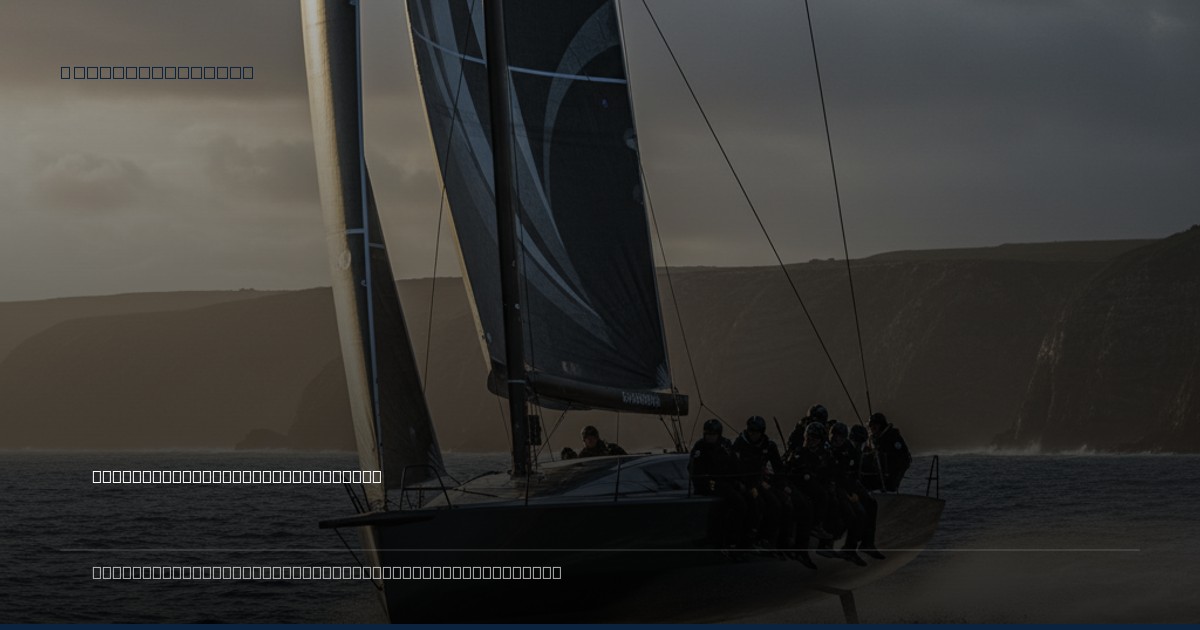
The lines between high-performance sailing and national security are blurring, and nowhere is this more evident than in the recent announcement linking American Magic Services (AMS) with Saildrone's groundbreaking Spectre platform. For those of us who've witnessed the relentless pursuit of speed and efficiency in the America's Cup, this collaboration is both logical and fascinating.
American Magic, a syndicate synonymous with pushing the boundaries of hydrodynamics and wing-sail integration, is now applying its hard-won knowledge to a 170-foot, 250-ton unmanned surface vehicle (USV). The Spectre, designed for anti-submarine warfare (ASW), demands the kind of precise engineering, materials science, and aerodynamic/hydrodynamic optimization that only a top-tier AC campaign can truly foster. Think about the stresses on an AC75's foils at 50 knots, or the intricate control systems managing a 26-meter wing sail – these are the very challenges AMS has mastered.
The implications are profound. The iterative design process, the computational fluid dynamics (CFD) analysis, the lightweighting strategies, and the robust systems integration perfected in the crucible of Cup racing are now directly contributing to a platform capable of 30 knots, operating autonomously for extended durations. This isn't just about a faster boat; it's about translating the relentless pursuit of marginal gains, a hallmark of competitive sailing, into a strategic advantage for defense. It's a testament to the ingenuity born from campaigns costing upwards of $100 million, proving that the investment in extreme sailing technology yields dividends far beyond the racecourse.