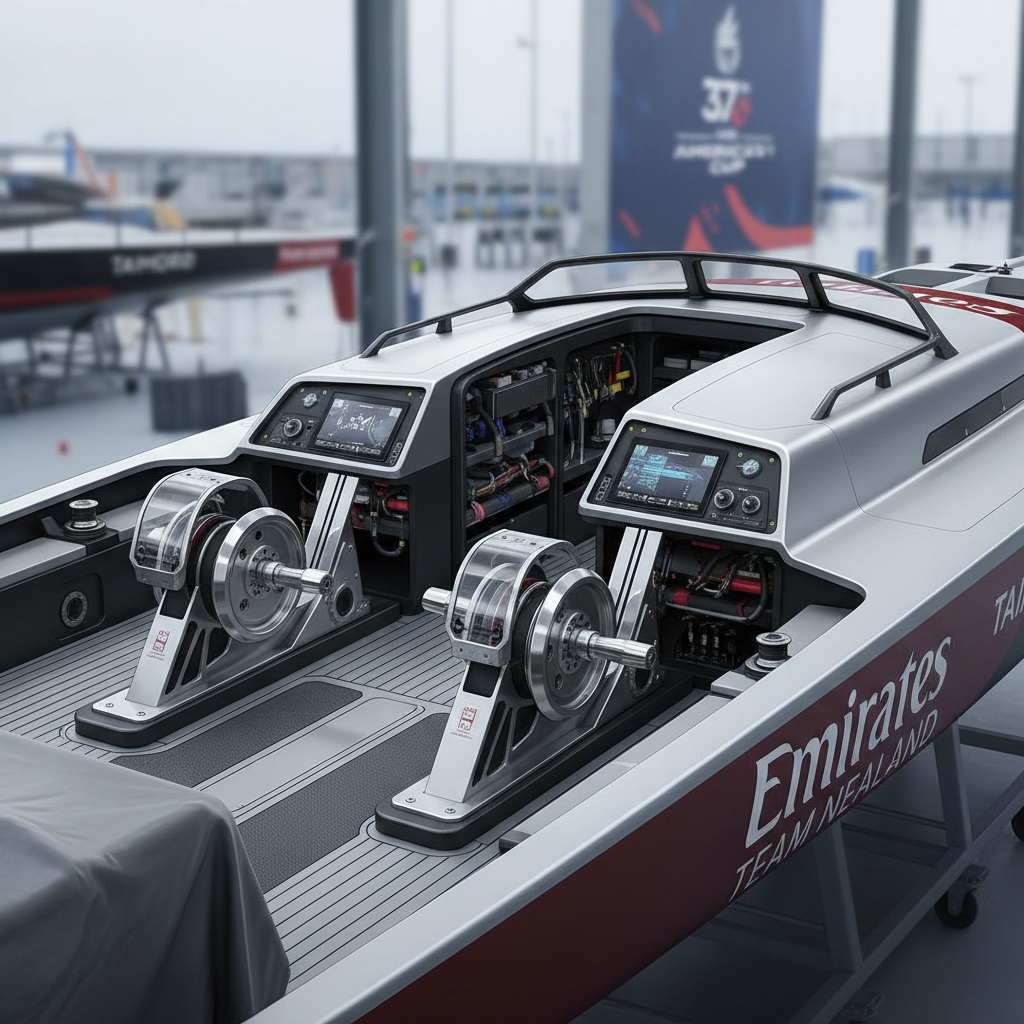
Auckland's Wynyard Point has once again become the crucible of America's Cup innovation, as Emirates Team New Zealand (ETNZ) rolled out their refitted AC75, 'Taihoro.' This isn't merely a fresh coat of paint; it's a profound engineering statement, signaling the direction of the 37th America's Cup.
The headline news, of course, is the crew reduction – from the original 11, then eight, and now a mere five sailors will wrangle these 75-foot foiling monsters. This isn't just about weight savings; it's a fundamental shift in onboard roles and automation. With the rule mandating the reuse of existing AC75 hulls from the 36th and 37th Cups, teams like ETNZ face a fascinating challenge: how to adapt a platform designed for a larger complement to a skeleton crew.
Taihoro's relaunch offers the first glimpse. Expect a significant overhaul of the hydraulic and control systems, likely pushing the boundaries of automated trim and flight control. The absence of six crew members means fewer bodies to power grinders, operate Harken winches, or manage sail trim. This necessitates more electric or battery-powered systems, demanding meticulous energy management. The 'cyclor' concept, pioneered by ETNZ, might see further evolution, or perhaps a complete re-think of power generation. The pressure on Peter Burling's helming and flight control, and the remaining crew's strategic input, will be immense. This evolution isn't just about speed; it's about making a $100M campaign viable with fewer hands, pushing the limits of technology to compensate for human muscle and dexterity.