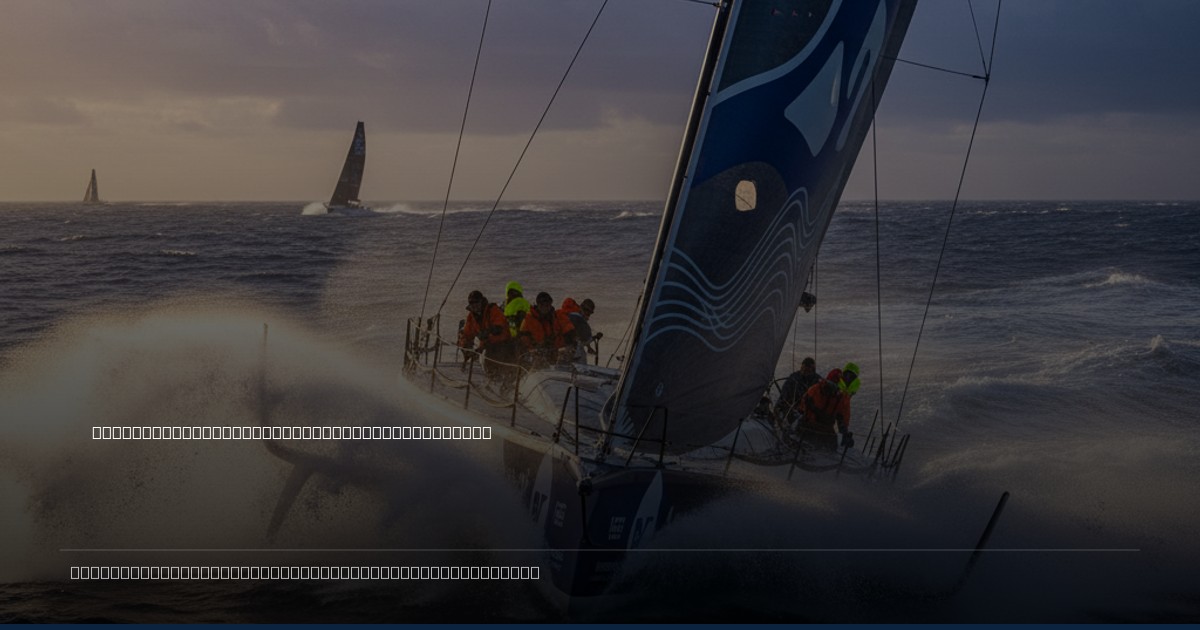
The sailing world holds its breath with every America's Cup cycle, every SailGP season, every grand prix regatta, not just for the speed and spectacle, but for the intricate dance of rules that govern our sport. The Racing Rules of Sailing (RRS) are our bible, and the Case Book, recently updated for 2025-2028, provides the crucial interpretations that shape on-water decisions. Case 87, in particular, throws a stark spotlight on the perennial tension between a right-of-way boat's privilege and its ultimate responsibility.
We've all seen it: a boat with right-of-way, perhaps a foiling AC75 screaming downwind, holding its line, expecting the give-way boat to do just that. Rule 10 is clear: when boats are on opposite tacks, the port-tack boat keeps clear. But Rule 14, the 'avoiding contact' rule, is the great equalizer. It states, 'A boat shall avoid contact with another boat if reasonably possible.' The nuance, as Case 87 illustrates, is in the timing: 'A right-of-way boat need not act to avoid contact until it is clear that the other boat is not keeping clear.'
Consider the scenario: P1 and P2 bear away, yielding to S. But P3, seemingly oblivious or perhaps misjudging, sails straight into S, causing significant damage. The protest committee's decision is brutal but instructive: P3 disqualified under Rule 10 for not keeping clear, and S, the right-of-way boat, also disqualified under Rule 14. This isn't some obscure club race; this is the kind of situation that can cost an America's Cup team millions in damage and a regatta victory.
Even with the advanced Harken hydraulics and Southern Spars rigs, or the precise wind strategy from North Sails, a collision can be catastrophic. The takeaway for every helmsman, from Olympic hopefuls to seasoned grand prix veterans like Peter Burling or Jimmy Spithill, is clear: while you have the right-of-way, you never have the right to collide. The moment it becomes 'clear' the other boat isn't yielding, the onus shifts. It's a high-stakes judgment call, often made in fractions of a second, that defines the very essence of competitive sailing.