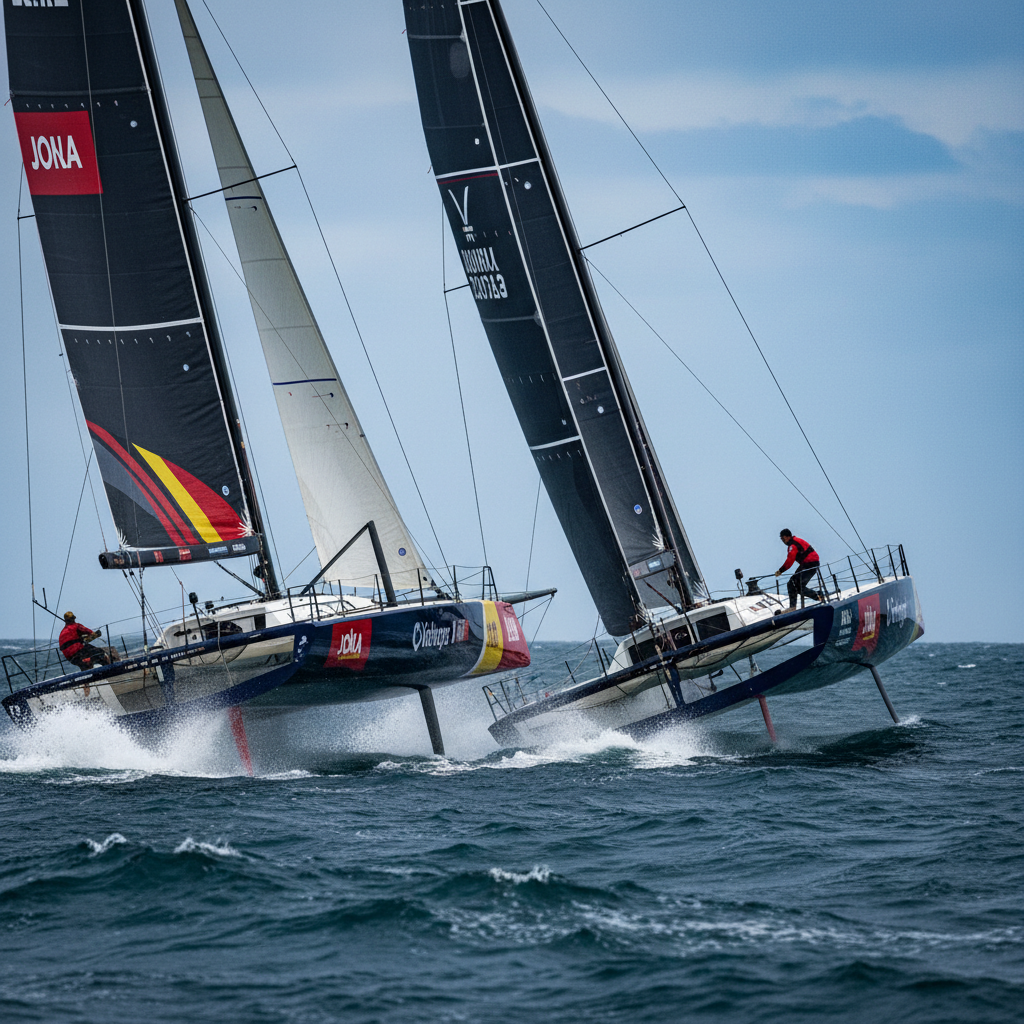
The latest World Sailing Case Book for 2025-2028, a vital companion to the Racing Rules of Sailing (RRS), has dropped, and Case 87 is already sparking robust debate in yacht clubs and strategy sessions worldwide. It's a stark reminder that even with clear right-of-way, the onus to prevent a collision remains a fundamental tenet of our sport, a lesson often learned the hard way.
The scenario is classic: three boats, P1, P2, and P3, bearing off below S, which presumably held right-of-way. P1 and P2 executed their maneuvers, avoiding S. P3, however, made no attempt to keep clear, resulting in a devastating, right-angle collision amidships with S. The protest committee's verdict? Both disqualified. P3 for breaking rule 10 (on opposite tacks, port gives way to starboard), and S for violating Rule 14 (Avoiding Contact).
This isn't merely academic. It underscores the nuanced interpretation of 'right-of-way need not act to avoid contact until it is clear that the other boat is not keeping clear.' What constitutes 'clear'? Is it a boat length, two, a sudden luff, or a failure to bear away? In the high-speed world of SailGP's F50s, where closing speeds are astronomical, or even a tight America's Cup pre-start, that 'clear' moment can be measured in milliseconds, not meters. Ben Ainslie or Peter Burling, masters of the pre-start, know this dance intimately, pushing the boundaries without crossing the line.
Rule 14 is the ultimate safety net, a non-negotiable. Even if you're perfectly in the right, a collision means you've failed in your duty to avoid contact once the other boat's transgression is undeniable. This case serves as a poignant reminder that while asserting your rights is part of competitive sailing, preserving the boats and the safety of the crew must always, always take precedence. A $100M America's Cup campaign can turn to splinters in an instant if this fundamental principle is ignored.