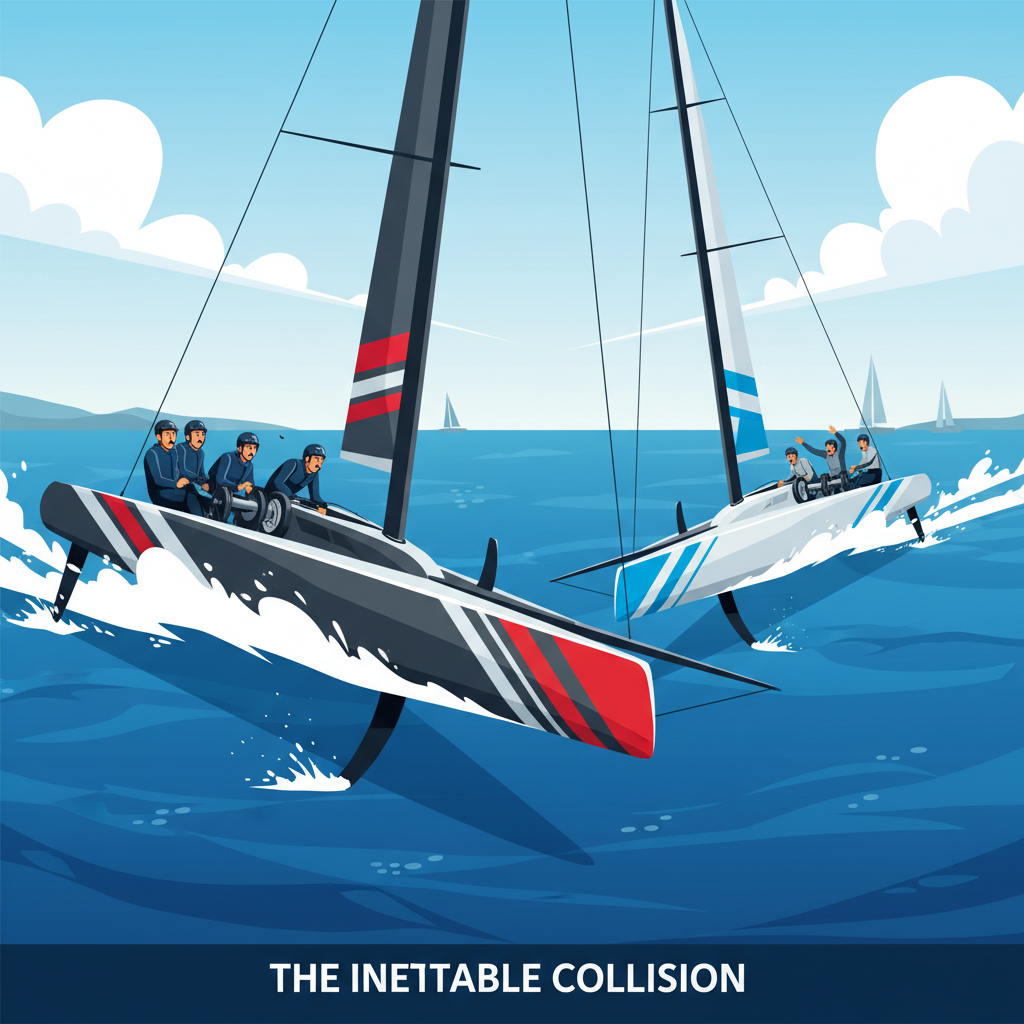
The sailing world thrives on precision, not just in boat handling and tactical calls, but in the nuanced interpretation of the Racing Rules of Sailing (RRS). The recently released 2025-2028 Case Book, a bible for competitive sailors and race officials alike, offers a stark reminder of this with Case 87: 'A right-of-way boat need not act to avoid contact until it is clear that the other boat is not keeping clear.'
This isn't new doctrine, but its application, as illustrated by the case, is a chilling testament to the unforgiving nature of Rule 14 (Avoiding Contact). The scenario describes P1 and P2 bearing off below S, a standard leeward mark rounding or tactical play. P3, however, failed to keep clear of S, striking her amidships at right angles, causing significant damage. The protest committee's decision? P3 disqualified under Rule 10 (On Opposite Tacks), and S, the right-of-way boat, also disqualified under Rule 14.
This ruling underscores a fundamental principle often overlooked in the heat of battle: while a right-of-way boat initially holds the advantage, it is not absolved of responsibility for avoiding contact once it becomes clear the other boat isn't keeping clear. For S, the moment P3's failure to keep clear became 'clear,' S had an obligation to act. Whether that action was a hard bear-away, a luff, or even a hail, the committee judged S's inaction as a breach of Rule 14. This isn't about culpability for the initial breach, which clearly lies with P3, but about the subsequent failure to prevent damage.
In the high-speed world of SailGP F50s or the America's Cup AC75s, where closing speeds are immense and maneuvers are executed on a knife-edge, this rule takes on even greater significance. A 'clear' indication can be mere seconds, demanding lightning-fast reactions from helmsmen like Peter Burling or Tom Slingsby. This case serves as a vital lesson for every sailor, from the weekend club racer to the Grand Prix circuit professional: understanding your rights is crucial, but so is understanding your responsibilities, especially when the stakes, and the damage, are high.