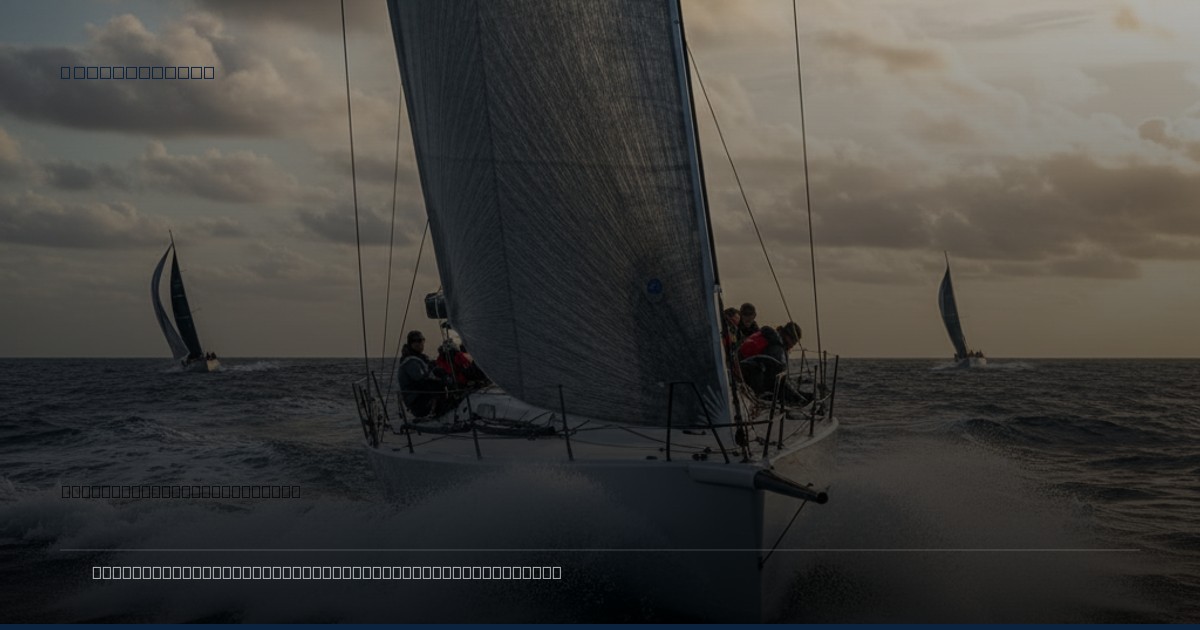
Conan O'Brien’s quip about AI taking over the Academy Awards might have been a laugh line in Hollywood, but in the high-stakes arena of competitive sailing, the notion of artificial intelligence dictating strategy is far from comedic – it’s a rapidly approaching reality.
We’ve seen the evolution: from the gut feel of a master tactician reading the wind and waves, to sophisticated weather routing software guiding solo circumnavigators. But the leap to real-time, dynamic tactical decision-making by AI? That's the frontier. Imagine an Emirates Team New Zealand AC75, its wing sail trimmed perfectly by Harken hydraulics, its Southern Spars mast humming, not just receiving data, but acting on predictive models that analyze wind shifts, current, tidal gates, and competitor positions with superhuman speed and accuracy. Would Peter Burling or Jimmy Spithill truly be 'driving' or merely executing the AI's optimal course?
Teams like INEOS Britannia and Luna Rossa already leverage vast datasets for design and performance simulation. The America's Cup, with its $100 million campaigns, is a hotbed for technological advantage. North Sails' sail design software is already incredibly advanced, but what if an AI could dynamically recut a sail's shape in a virtual environment based on real-time atmospheric pressure changes across the course? The human element – the 'feel' for the boat, the psychological warfare, the split-second intuition – remains paramount. But as AI refines its ability to process more variables than any human brain, the role of the tactician, the navigator, even the helmsman, will undoubtedly evolve. The question isn't 'if' AI will influence the grand prix circuit, SailGP, or even Olympic sailing, but 'when' it will hold the algorithmic helm.