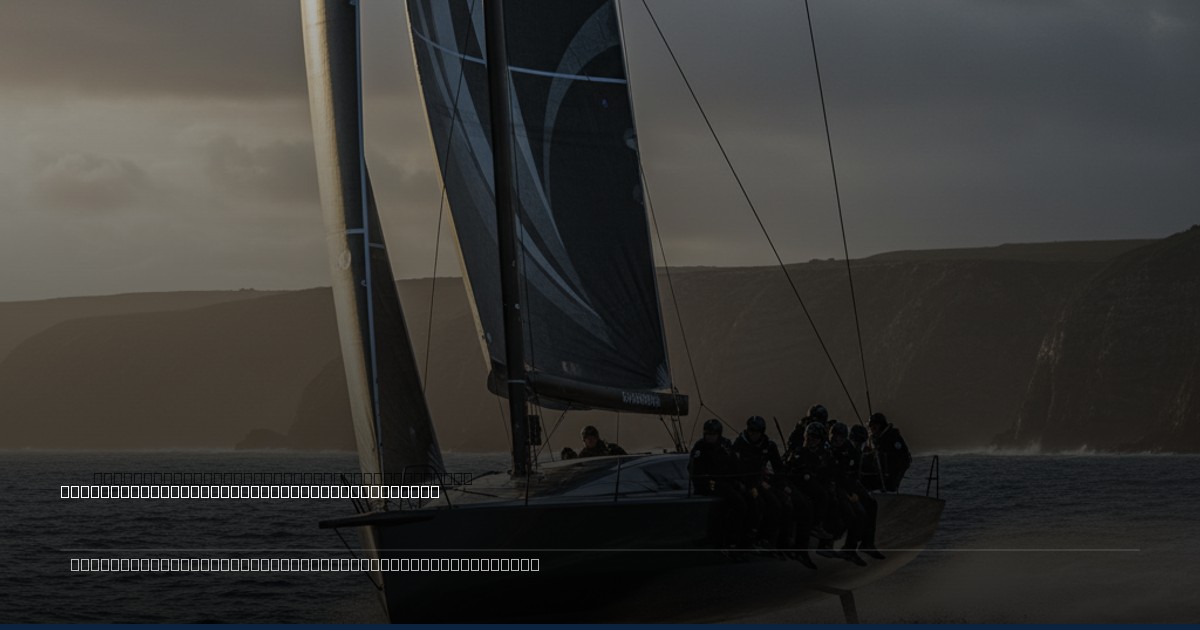
For decades, the America's Cup has been a crucible of innovation, a no-holds-barred engineering arms race where budgets stretch into nine figures and the pursuit of a single knot of boat speed drives breakthroughs that eventually trickle down to the broader marine industry. Now, it appears that trickle has become a torrent, flowing directly into the strategic waters of national defense.
News from Pensacola confirms that American Magic Services (AMS), the operational arm of the New York Yacht Club's America's Cup challenger, has been tapped by Saildrone for their formidable new 'Spectre' platform. This isn't just another unmanned surface vessel (USV); at a staggering 170 feet and 250 tons, capable of a blistering 30 knots, Spectre represents a quantum leap in autonomous maritime capability. Its primary mission: anti-submarine warfare (ASW), a domain where stealth, endurance, and precise hydrodynamics are paramount.
The implications are profound. The expertise honed by American Magic in optimizing foil design, wing sail efficiency (or in this case, perhaps a highly advanced rigid wing for autonomous propulsion), and sophisticated sensor integration for high-speed, dynamic operation on their AC75s is directly transferable. Imagine the computational fluid dynamics (CFD) models used to shave milliseconds off a tack, now applied to minimizing acoustic signatures or maximizing loiter time in a patrol zone. The 'black box' knowledge gained from pushing the boundaries with Harken winches, Southern Spars rigs, and North Sails membranes is now a strategic asset.
This partnership underscores a fascinating evolution. The relentless pursuit of competitive advantage on the racecourse has inadvertently forged a capability that is now critical for global security. It's a testament to the unparalleled engineering prowess within the America's Cup ecosystem, proving once again that sailing's grandest spectacle is far more than just a race; it's a laboratory for the future of marine technology.